How many hospitals does Ethiopia have?
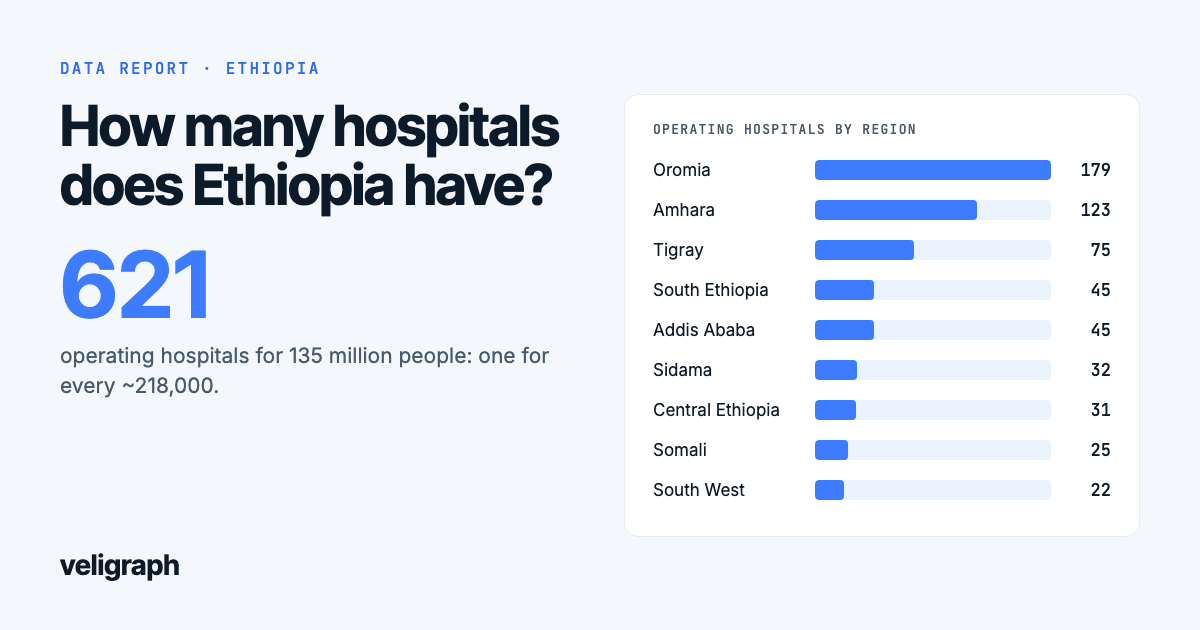
Ethiopia's national register lists 64,959 health facilities, and 56,049 of them are recorded as operating, about one for every 2,417 people. But only 621 are operating hospitals. For a country of roughly 135 million, that is one hospital for every 218,000 people.
The headline number
Of the 56,049 operating facilities, most are not hospitals at all. The register divides them like this:
- 16,042 health posts, the village-level base of the system, staffed by health extension workers
- 4,157 health centres, which each serve a cluster of health posts
- 16,618 clinics, almost all of them private
- 15,766 pharmacies and drug shops
- 621 hospitals
The register lists 634 hospitals in total; 13 are recorded as closed or not functioning, leaving 621 that are operating.
Three tiers of hospital
Ethiopia grades its hospitals in three tiers, and the tier is usually part of the hospital's name. Among the 621 operating hospitals:
- 386 primary hospitals, the first level of inpatient care, each meant to serve a few hundred thousand people
- 188 general hospitals, which take referrals from primary hospitals and health centres
- 32 comprehensive specialized and referral hospitals at the top of the system, including ALERT, Tikur Anbessa (Black Lion), Gondar, Ayder in Mekelle, Hawassa University
A further 15 hospitals do not state a tier in their registered name.
Who owns them
Hospitals are mostly public: 434 of the 621 operating hospitals are government-run, 177 are private for-profit and 10 are non-profit. Across all facilities the picture flips. Private operators run 32,877 facilities against 23,138 public ones, because nearly all clinics and pharmacies are private.
Addis Ababa is the outlier. The capital has 45 operating hospitals, but only 12 of them are public. Everywhere else, the government runs most hospitals.
Listed is not the same as open
The register is unusually candid about closures: 8,406 facilities are recorded as closed, about one in eight of everything listed. Oromia has 2,850 closed facilities and Addis Ababa 1,313. In Gambella, 216 of 792 listed facilities are closed, more than a quarter. A count of "health facilities in Ethiopia" that includes closed sites will overstate what is actually available.
Doctors and beds are the real constraint
By World Bank figures, Ethiopia has about 0.143 doctors per 1,000 people (2023), roughly one doctor for every 7,000 people, and about 1.222 nurses and midwives per 1,000 (2022). The most recent hospital-bed figure, 0.33 beds per 1,000 people, dates from 2016. Ethiopia has built out primary care through its health extension programme, which is why operating health posts outnumber hospitals by about 26 to 1, but specialist care remains concentrated in a few dozen referral hospitals.
Region by region
Oromia, the most populous region, has the most facilities by far: 19,575 operating, including 179 hospitals. Tigray stands out for its size, with 75 operating hospitals, more than any region except Oromia and Amhara.
| Region | Facilities | Hospitals | Public hospitals | Health centres | Health posts |
|---|---|---|---|---|---|
| Oromia | 19,575 | 179 | 130 | 1,485 | 6,080 |
| Amhara | 10,539 | 123 | 103 | 951 | 3,134 |
| Somali | 4,463 | 25 | 19 | 267 | 1,577 |
| Addis Ababa | 4,113 | 45 | 12 | 152 | 0 |
| South Ethiopia | 3,857 | 45 | 36 | 299 | 1,341 |
| Central Ethiopia | 3,037 | 31 | 26 | 247 | 1,081 |
| South West Ethiopia | 2,850 | 22 | 18 | 135 | 752 |
| Tigray | 2,609 | 75 | 38 | 245 | 640 |
| Sidama | 1,542 | 32 | 23 | 144 | 478 |
| Benishangul-Gumuz | 1,417 | 9 | 7 | 67 | 418 |
| Afar | 859 | 14 | 12 | 104 | 356 |
| Gambella | 575 | 5 | 5 | 30 | 122 |
| Dire Dawa | 332 | 10 | 2 | 17 | 36 |
| Harari | 275 | 6 | 3 | 14 | 27 |
Operating facilities only. Open any region for its full list of facilities, or browse the Ethiopia facility index. For how Ethiopia compares with the rest of the continent, see Africa's health facilities by the numbers.
Facility counts, types, ownership and operating status are from Ethiopia's Master Facility Registry (Ministry of Health, 2025). Hospital tiers are read from registered facility names. Population, doctor, nurse and bed ratios are from the World Bank.
Sources
- Ethiopia Master Facility Registry, Ministry of Health, facility counts, types, ownership and operating status (2025)
- World Bank: population, Ethiopia (2025)
- World Bank: physicians per 1,000 people
- World Bank: nurses and midwives per 1,000 people
- World Bank: hospital beds per 1,000 people
Register figures are shown as recorded; anomalies are flagged, not edited. Method and limitations: how Veligraph is built.